Mission

FASHION, ART CRAFTS & DESIGN CAMPUS
Leading territory for craftsmen and designers, Paris and the Île-de-France region offer a key scenery for those professionals, but above all a wealth of training facilities characterized by the excellence of the institutions, the variety of training programs (from secondary school to research), and the attendance of major cultural and artistic partners with uncontested prestige.
The Fashion, Art Crafts and Design Campus of Excellence – Paris, Manufactures des Gobelins, supported by the École des Arts Décoratifs de Paris, was created from a shared desire to leverage this remarkable wealth, to enhance these educations of excellence, and to meet the needs of creative industries through association with companies, craftsmen, foundations and philanthropists who bring this dynamic economic sector to life. The Campus of Excellence in Trades and Qualifications is embedded in an exceptional partnership with the National Furniture (Mobilier National), also a founding member. Through this fruitful collaboration with a major institution of the Ministry of Culture, the desire to promote vocational training is carried out by the Ministry of National Education, Youth and Sports and the Ministry of Higher Education, Research and Innovation in conjunction with the Ministry of Labour, Employment and Integration.
Conceived as a genuine incubator, a space for reflection and exchange unique in France, the Campus allows to observe, analyse, recommend and implement experiments serving pedagogical, technological and professional innovations, and the major challenges of sustainable development and ecological transition.
The Fashion, Art Crafts and Design Campus – Paris, Manufactures des Gobelins has 4 strong ambitions:
— To promote and enhance the professions and trainings of excellence in the arts and design on a territorial and international scale,
— To develop and adapt training programs in line with economic and social perspectives to build success journeys for all audiences,
— To facilitate professional integration throughout the course of life and to strengthen exchanges and partnerships between training institutions and economic actors,
— To revitalize professional practices and assist the development of trainings and companies through research, innovation and development of skills.
The collaborative action mode grows through the cooperation and articulation between training institutions and companies:
— Initiation and animation of a coordination network of Ile-de-France actors in art crafts and design,
— Development of meeting sessions between companies, designers and craftsmen to strengthen collaborations and the appropriation of design by economic actors,
— Development of training programs opened to workers as part of partner companies' skills development plans and for jobseekers
— Development of meeting events between young craftsmen, designers and recruiters in the Ile-de-France area,
— Carry out of a shared diagnosis about the training offer in the Ile-de-France area in design and crafts,
— Creation of a regional showcase presenting students' diploma projects,
— Organization of workshops and innovative inter-school educational factories,
— Creation of common educational tools for monitoring and analysis,
— Coaching for entrepreneurial ambition through the development of dedicated trainings,
— Exhibition and promotion of research and productions,
— Development of an international policy on behalf of training.

GOBELINS MANUFACTURE
For more than three centuries, the Royal Furniture Repository, which became Imperial Furniture and then National Furniture, has preserved, restored and maintained around 100,000 objects, furniture and textile works intended for the presidential residences. The institution perpetuates the transmission of exceptional skills and pursues research for innovation. The Manufacture nationale des Gobelins, which hosts the Campus in its heart, has been affiliated with the administration of the Mobilier national since 1937. The Campus' location inside the Manufacture des Gobelins leads to premises and spaces designed in a collaborative perspective with the Mobilier national teams.
The spaces are organized around three complementary functions:
— The demonstration and exhibition dimension – addressing the challenges related to the attractiveness of the industry and highlighting skills and trades,
— The dimension of encounter and experimentation – responding to the challenges of pedagogical innovation, crossing approaches and new modes of learning and training,
— The dimension of resource and research center – in connection with the challenges of technological innovation, the needs of tomorrow's trades, professional integration and the development of research.
These platforms will complement the production workshops and resource centers of the various partners to develop innovative practices:
— Material library and Documentation Centre offer a collection dedicated to materials, and are built around environmental criteria,
— Fablab provides rapid prototyping devices for project design, an assembly and experimentation site,
— Group and individual workspaces that facilitate consultation, research and design work.

ECONOMIC SEGMENT
Art crafts and design belong to creative industries and involve a myriad of professions. This sector meets currently a strong infatuation on the international scene, and activities related to these industries are considered as a strategic advantage and a driver of the economy.
— Characteristics of the Art Crafts
The Institut National des Métiers d'Art (INMA) estimates that, in 2018, there were 60,000 art craft companies in France, while the Institut Supérieur des Métiers (ISM) estimated in its latest study, updated in March 2019, that the most relevant order of magnitude for counting the companies falling within the scope of the arts crafts is 70,000 companies. The study is based on the APE code for companies and identifies 52 activities in the arts and crafts. These are only craft companies, as large companies and multinationals that employ workers in the field of arts and crafts are not listed.
Historic melting pot of art crafts, with intense activity through the 18th and 19th centuries, the Île de France region concentrates the largest number of art craft companies in France (20%). This means 5,200 craft companies (i.e. nearly 3% of all regional crafts) which employ a total of 7,850 employees and craftsmen. The Île de France Region carries the most important international trade fairs in the sector on its territory: the Carrousel des métiers d'art et de creation, the Cultural heritage fair, Maison & Object, the Pantin Est-Ensemble biennial, the Revelations fair. Furthermore, the wide number of Parisian and national museums requires the best craftsmen in France to preserve and renovate their gilding, tapestries, fabrics, old books, etc., while major performance venues (Comédie française, Paris Opera, etc.) work with decorators, prop masters or costume designers. The region also hosts some prestigious manufactures that generate employment: the Gobelins, Sèvres and Savonnerie manufactures. These premises are therefore providers of jobs that cannot be relocated and have perennial activity.
— Luxury Industry: A Decisive Contributor
Luxury companies need multiple skills to stimulate an ambitious creation. Driven by a permanent dynamic of innovation and a deep culture of excellence, their role is decisive in the transmission and influence of the art crafts. The 83 renowned houses gathered in the Comité Colbert have a combined turnover of more than 42 billion euros, and 86% are generated by sales outside France. The luxury sector is their main economic opportunity for the arts and crafts, but, while this relationship is essential and even vital for the creative professions, it is neither exclusive nor systematic.
Different segments of luxury involve art crafts and design, at multiple levels:
— the luxury sector, which encompasses products that are often unique and tailor-made (haute couture, high jewellery, silverware, crystal glass, etc.)
— the intermediate sector, which corresponds to the traditional luxury sector (ready-to-wear, leather goods, etc.)
— accessible luxury, "the luxury of sensations and pleasures" (perfumery, gastronomy, etc.).
— Design: the factor of competitiveness
Through its ability to anticipate practices, design supports companies in their innovation projects, and ever more public services are calling on designers to support their transformation projects. The Île de France features many assets: renowned designers, a network of schools and premises of support for diversified creation, international companies that place design at the heart of their development strategy. Through its ability to anticipate practices, studies demonstrate the added value of design as a leverage for transformation, a factor of originality, an accelerator of change, with the capability to intervene in extremely varied fields.
Design generates a competitive advantage for companies through its impact on the marketing of a product/service and through innovation management. In companies that invest twice as much as the average in creative resources, the probability of launching innovative products is 25% higher.
DOCUMENTATION
Rapport d’activité 2025 2025 Rapport d'activité 2024 2024 Rapport d’activité 2023 2023 Rapport d’activité 2022 2022 Rapport d’activité 2021 2021Programs
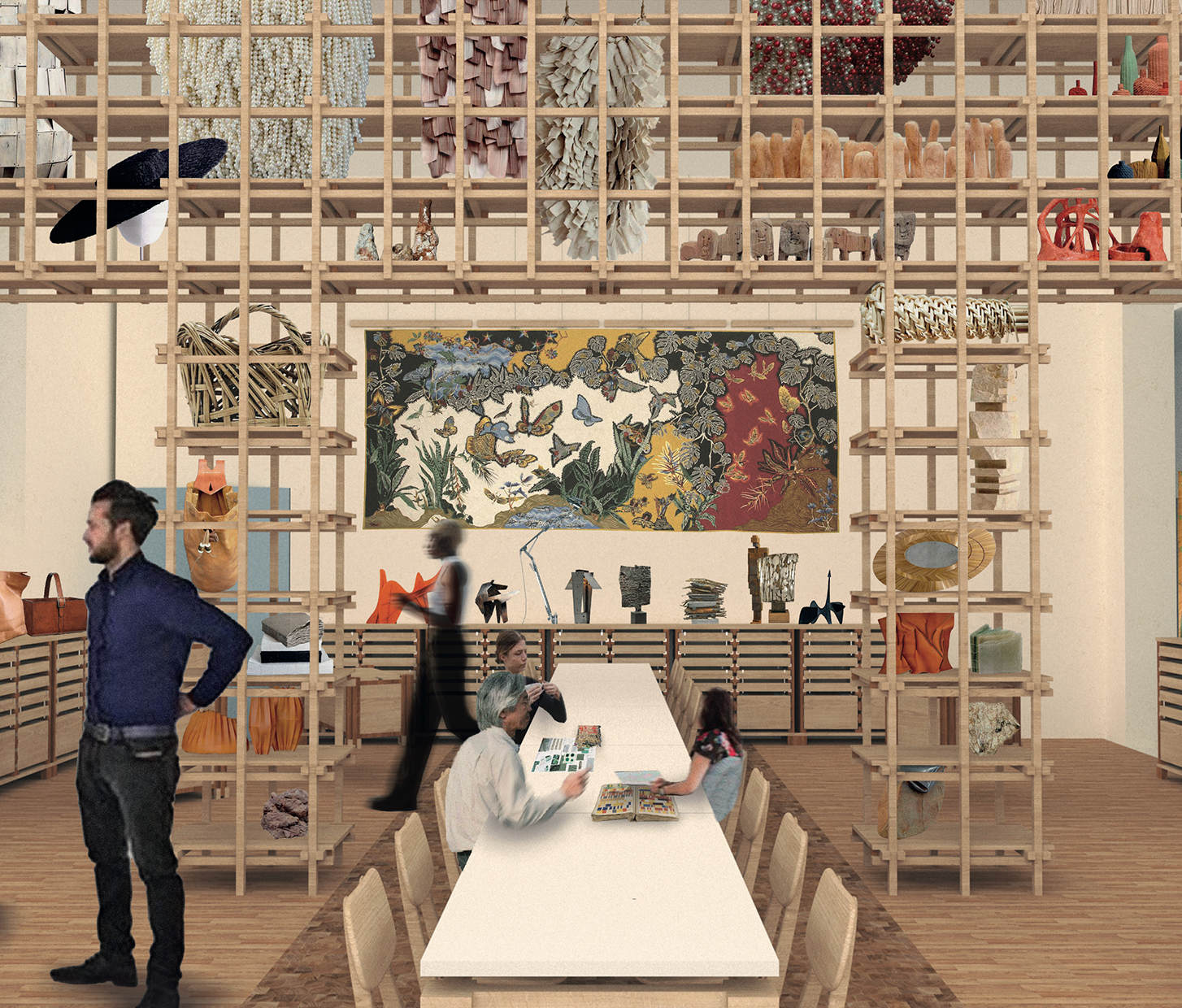
GREAT MATERIAL LIBRARY
The Great Material Library, future resource centre on materials
The Fashion, Art Crafts, Design Campus – Manufacture des Gobelins, the Mobilier national and the École des Arts Décoratifs - PSL are carrying out a project to create a Great Material Library, shared and accessible to all their academic and professional partners.
This project aims to create a unique resource centre on materials and processes for the inspiration and training of students and teachers of creative disciplines as well as their linked relations with the professional world. The Great Material Library intends to be a storefront for traditional and innovative practices in the arts and crafts, fashion and design through the material aspect, and to encourage the ecological transition and synergies in these sectors.
The missions of the Great Material Library
The fields and expertise featuring within the project's partner institutions deserve to be highlighted and create a wealth that will be concretely accessible to all through the sample collection. Along with a place to develop interest through the sensitive approach to materials and skills, the Great Material Library aims to train users, developing their theoretical knowledge, particularly on the environmental aspect. Further than resources, the mission of this new space is to promote meetings and interdisciplinarity, in an organic way, between all the audiences of the project's partner institutions.
A premise in the heart of national manufactures
The project will settle in the Chabrol building, within the Mobilier national, behind the Manufacture des Gobelins building. The ground floor, with an area of about 200 m² (about 240 square yards) will house the collections of the Great Material Library. The interior design has been tailored by students from the École des Arts Décoratifs – PSL in Object Design and Interior Architecture, winners of the 2024 National Furniture Young Creation Prize.
The "Laid Bare Material" reveals the work of the actors of the contemporary creation
The Great Material Library team organises and enlivens a range in the cultural programme entitled "Laid Bare Material". This happens as panel discussions, so the audience can discover the work of creative professionals: designers, artists and craftsmen. The material is at the heart of their practice, and they are committed to passing on their passion. Alongside the meetings, which take place in public, some contributors are interviewed in the privacy of their workplace, which then results in the publication of podcasts available online.
A digital and participatory database
The digital database of the Great Material Library collection makes the material sheets remotely accessible to all members and partners of the Fashion, Art Crafts & Design Campus – Manufacture des Gobelins. The platform is participatory, so all the audiences of the partner institutions can contribute, suggesting the entry of new samples of materials into the collection. Events and news related to the project are at disposal, as well as documentary contents created by the Great Material Library team.
Access to the database

RE-SOURCE FRANCE 2030
— Development of training linked to cultural industries of excellence
The Fashion, Art Crafts and Design Campus – Manufacture des Gobelins, supported by the École des Arts Décoratifs, will receive €9 million as help in the project France 2030 to implement "Re-SOuRCE": a project to promote the transmission of skills, the creation of new tools, the development of reusability and circularity in the cultural industries of excellence.
Led by the Fashion, Art Crafts and Design Campus, supported by the École nationale supérieure des Arts Décoratifs, in partnership with several educational institutions and economic contributors from the sector. Re-SOuRCE is divided into 3 training streams, initial and continuing.
— Conservatory of Art Crafts and crafting to meet the challenge of generational transition.
In concrete terms, the project aims to preserve and transmit the skills in crafts which constitute one of the most precious intangible heritages in France. With collaborative robotics and human-centred artificial intelligence, the facility will capture the craftsman's expert gestures, transcribe them and preserve them to ultimately serve as a support for the training of future generations of apprentices.
— Circular Innovation & Creation Program to meet the challenge of the ecological transition
The purpose is to develop specialization training at the national level, focused on the skills and know-how of circularity in creation. All the educational contents will be developed in partnership with actors from the professional and associative areas.
— Fashion Step-stone with Impact program to meet the challenge of transforming entrepreneurship in the creative professions.
Creation of a technological innovation centre to meet the ecological challenges of the cultural and creative industries sector.
To achieve these three components, the Fashion, Art Crafts and Design Campus, supported by the École des Arts Décoratifs and the consortium of academic and economic contributors, such as the Comité Colbert, will be backed up to the tune of 8,933,000 euros.
Academic actors: École nationale supérieure des Arts Décoratifs and its research laboratory EnsadLab, École nationale des Chartes – PSL, ENAMOMA – PSL, Groupements d'intérêt public Formation et Insertion Professionnelles of Nice Academy (GIP FIPAN), and the Académie de Paris (GIP Paris), Institut Français de la Mode (IFM), Lycée du Dauphiné, MAKE ICI, Mines Paris – PSL and Mines Saint-Étienne, University of Paris Nanterre.
Economic contributors: Centre de recherche des arts verriers (CERFAV), Chambers of Trades and Crafts (Provence-Alpes-Côte d'Azur and Auvergne – Rhône-Alpes), Comité Colbert, Christofle, Van Cleef & Arpels, Made in Montreuil, Valesens, etc.
Territorial actors: Pôle Emploi Provence-Alpes Côtes d'Azur
N.B. In October, the President of the French Republic, Emmanuel Macron, unveiled an investment plan called France 2030. With €54 billion invested across the entire value chain of our industries, France 2030 aims to accelerate the transformation of key sectors of our economy through innovation and to rank France not only as a contributor, but as a leader in the world of tomorrow. With a total of one billion euros in endowments, Culture comes up to the mark of these future transformations.
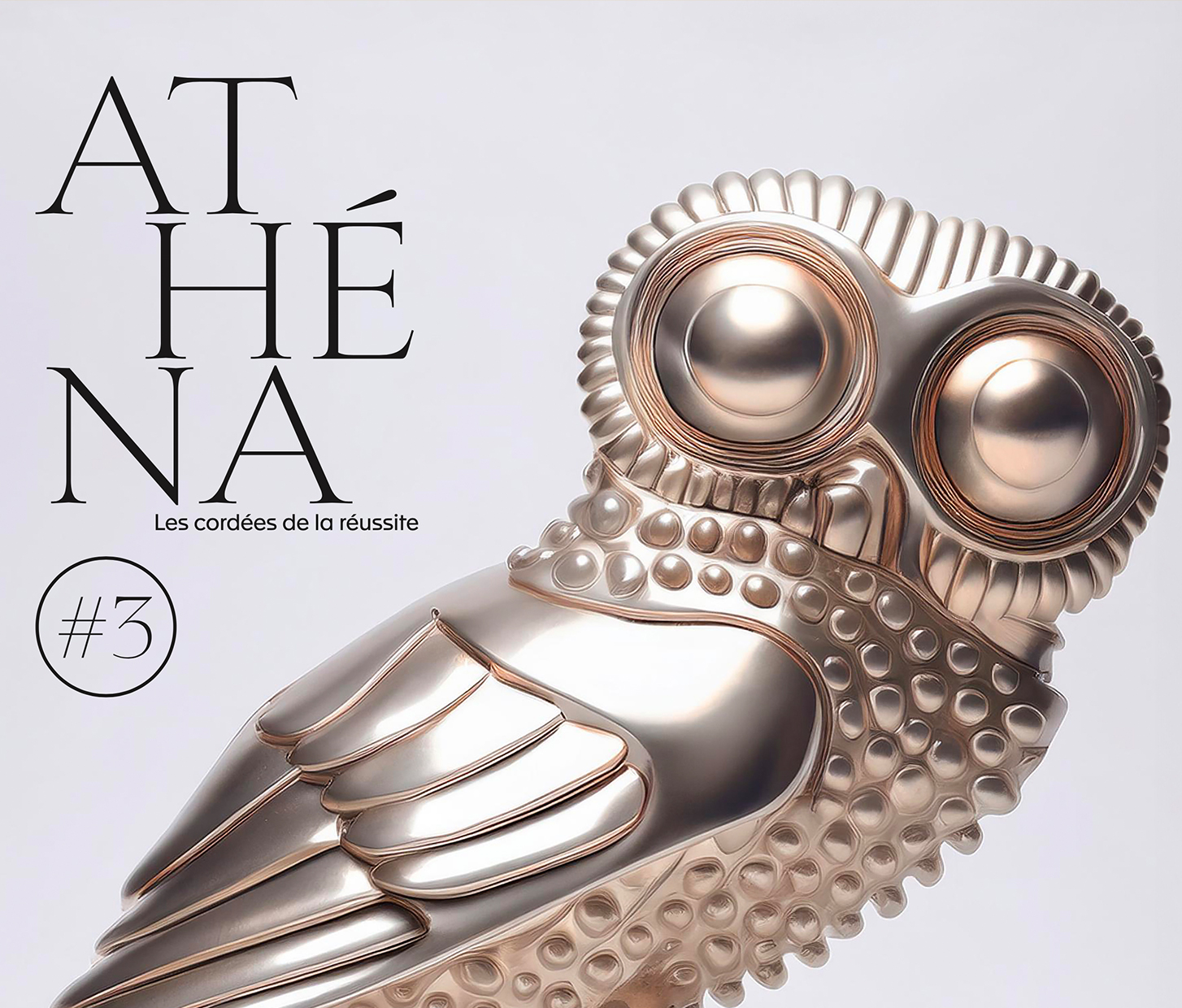
ATHENA, ROPED FOR SUCCESS
For the first time in 2022, the Campus has developed, as a response to the proposal of vocational high schools, an original format of the Roped for Success dedicated to the arts and crafts for middle school students. The Athena Ropes were conceived with the management teams of 6 partner schools to introduce 4th and 3rd grade students to the know-how and passion of the teaching teams who mentor them and the students who train in the CAP, BMA and Professional Baccalaureate in craftmanship and art crafts on the Campus. Through a program of initiation and experimentation, guidance and tutoring, cultural openness, discovery and exhibition, the Athena Ropes offer a unique journey of advocacy to the creative professions. The originality of this programme lies in the breadth of the spectrum of the involved public, turned to students, raising awareness among the middle school teachers in charge of the implementation of the Journey for Future, and involving the parents of students through cultural outings and the organization of an exhibition at the Gobelins chapel, which recreates the entire journey for the 18 involved schools. The Corvisart-Tolbiac, Diderot, Lucas de Nehou, Léonard de Vinci, Octave Feuillet and Turquetil high schools open their doors to Parisian middle school students for an exceptional opportunity to tackle the materials and tools for the first time, during a week of immersive training in the workshops, supervised by teachers and high school tutors. The Ropes for Success scheme is a national programme to guide pupils in their career paths, whose implementation is financed by the Paris Academy and the Île-de-France Region.
The Ropes for Success scheme is a national programme to guide pupils in their career path. The Ropes for Success aim to fight against self-censorship, to broaden horizons and to arouse students' academic ambitions through continuous and progressive support upstream of career choices. The Athena Ropes introduce students from partner middle schools to the know-how, virtuosity and passion of the teaching teams who mentor them and the students who train in a dozen of the 34 establishments that make up the Fashion, Art Crafts and Design Campus.
DOCUMENTATION
Livret La Grande MatériauthèqueDOCUMENTATION
Livret Athéna #3 2024
LA MATIÈRE MISE À NU
La matière mise à nu est la programmation de la Grande Matériauthèque du Campus Mode, Métiers d’art & Design
Le podcast La matière mise à nu est une série d’entretiens proposant une diversité de regards, d’expertises et de pratiques pour favoriser la diffusion de connaissances sur les matériaux, leur description et leur appropriation par les disciplines créatives, ainsi que leurs enjeux en terme d’impact environnemental et de circularité.
BACHELOR EMA
Une formation Bac+3 pour créer son entreprise dans les métiers d’art
Conçu en co-construction par le Campus et les équipes du Cnam le Bachelor “Entreprendre dans les Métiers d’Art”, offre une réponse inédite et pragmatique aux besoins d'insertion professionnelle et de compétences entrepreneuriales. Cette formation de trois ans s'appuie sur la transdisciplinarité et l'hybridation, offrant aux étudiants de la voie professionnelle en métiers d'art une approche novatrice pour construire leur projet entrepreneurial.
Les étudiants inscrits bénéficient de 3 années de formation : 1200 heures sont consacrées au renforcement des compétences « cœur de métier », aux savoir-faire des métiers d'art et à l'acquisition des nouvelles connaissances et compétences dans le domaine de l’entrepreneuriat, 2400 heures dédiées à l'application de ces connaissances sur le terrain.
En rejoignant ce parcours, les étudiants intègrent un environnement où les enseignements se matérialisent par la pratique. L'équipe, constituée d'experts du Cnam et de formateurs intervenants en design et en métiers d’art, guide les étudiants tout au long de leur parcours. La première année de formation offre une transition douce entre la formation pré-bac et les études supérieures en permettant aux étudiants de suivre les enseignements liés à la réalisation et à la pratique dans les ateliers des spécialisations des lycées professionnels partenaires, accompagnés par des formateurs spécialistes de leur domaine.
Ce Bachelor offre une opportunité unique d'explorer les rouages de ces métiers tout en développant des compétences entrepreneuriales. Une expérience de formation sur-mesure conçue pour préparer les étudiants à un futur professionnel concret et stimulant.

Consortium ERASMUS+
Depuis 2025, le Campus Mode, Métiers d’Art & Design (MoMADe) pilote, en lien étroit avec 10 établissements partenaires, un consortium ERASMUS+ dans le cadre du programme de l’Union européenne — un dispositif majeur dédié à l’éducation, à la formation et à la jeunesse en Europe.
Membres du consortium
Lycée Maximilien Vox
Lycée Initiative
Lycée Auguste Renoir
Lycée Paul Poiret
Lycée Hector Guimard
Institut Sainte-Geneviève
École du Verre de Paris
Lycée Eugénie Cotton
Lycée La Source
Campus Fonderie de l’Image
Cette dynamique collective marque une étape significative dans l’ouverture à l’international des établissements impliqués.
Elle reflète une volonté commune de :
Favoriser la mobilité des élèves et des équipes pédagogiques
Encourager les échanges interculturels
Renforcer les coopérations européennes dans les domaines de la mode, des métiers d’art et du design
Des opportunités concrètes grâce à ERASMUS+
Mobilité étudiante
Possibilités d’échanges académiques ou d’immersions dans des établissements partenaires en Europe pour poursuivre des cursus diplômants ou pour des stages profesionnels.
Ces expériences bénéficient d’un financement dédié via le programme ERASMUS+.
Mobilité du personnel
Accès à des formations, missions d’enseignement ou séjours d’observation permettant de développer les compétences, d’enrichir les pratiques professionnelles et le partage des savoir-faire, notamment dans les champs des métiers d’art, de la mode et du design.
Partenariats européens
Développement de projets collaboratifs, co-création de contenus pédagogiques et exploration d’innovations éducatives en lien avec des structures partenaires à l’échelle européenne.
L’intégration au programme ERASMUS+ inscrit pleinement ce consortium dans une dynamique européenne fondée sur le partage, l’innovation et la solidarité, tout en valorisant les savoir-faire, la créativité et l’excellence des formations dans les filières artistiques et créatives.